How to Cycle an Axolotl Tank
Fishless cycling is the essential science of preparing your tank's biological ecosystem before your axolotl arrives. By establishing a colony of beneficial bacteria, you create a dedicated ‘clean-up crew’ that naturally neutralizes waste. For your sensitive aquatic friend, this means constant protection from invisible toxins, ensuring they flourish in water that remains clean, safe, and perfectly balanced from day one.
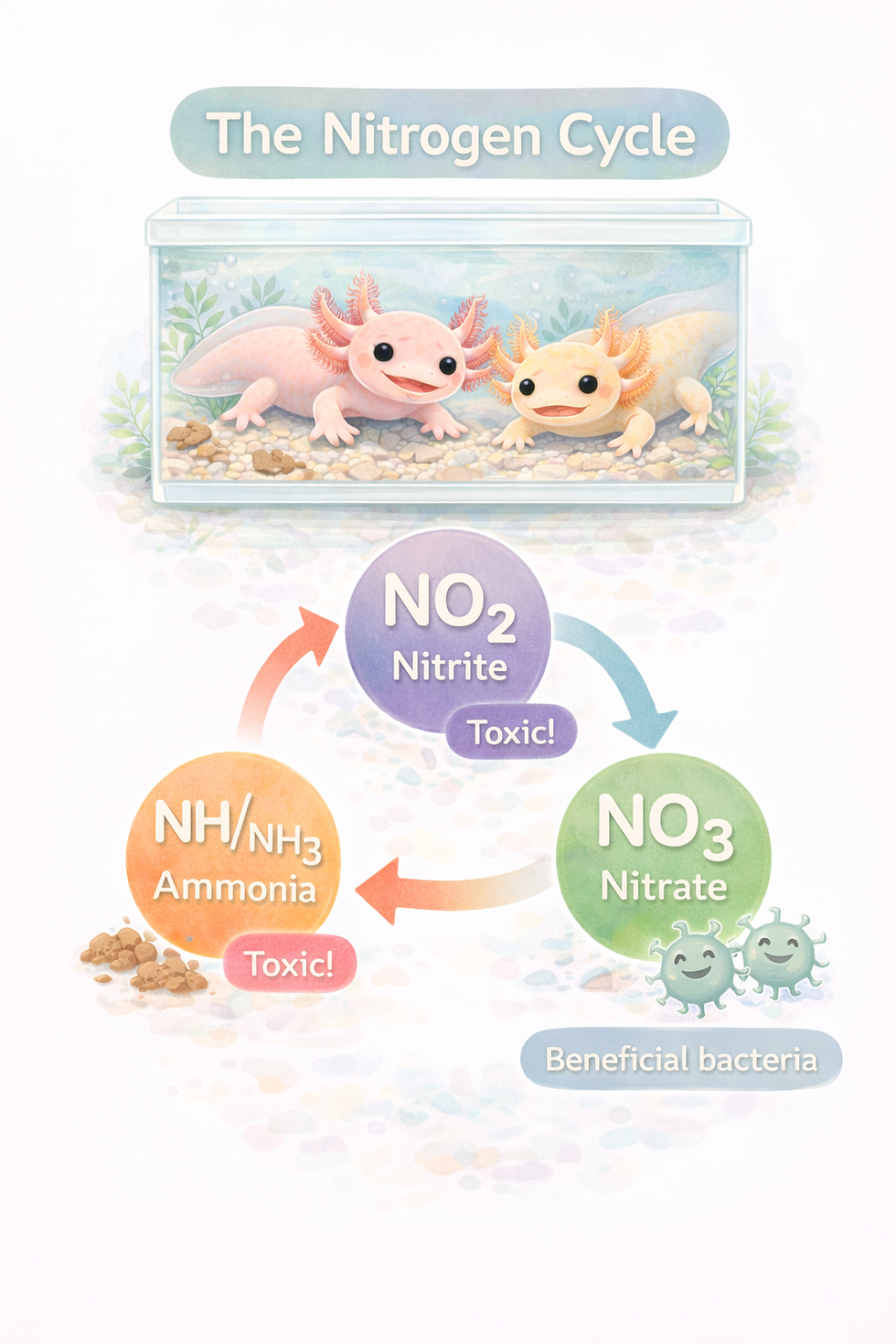
The Nitrogen Cycle Explained

Ammonia: The Messy Guests
Think of ammonia as messy guests at a party. It comes from waste and leftover food, and it’s much too spicy for axolotls to handle on their own.

Nitrite: Tiny Clean-up Crew
Your first crew of bacteria turns ammonia into nitrites. It's a big step in cleaning, but this squad is still working hard to refine the water quality further.

Nitrate: The Final Goal
The second crew finishes the process by creating nitrates. These are like harmless dust left after tidying—you remove them with your weekly water changes!
Setting Up for Fishless Cycling
Before you begin the cycle, ensure you have all the essential equipment ready. Consistency and the right tools are key for building a healthy, stable axolotl home.

Appropriate Tank
A 20-40 gallon long aquarium is the gold standard for providing enough space and water volume for stability.

Low-Flow Filter
Sponge filters provide excellent surface area for bacteria without creating stressful strong currents.

Chiller or Fans
Axolotls need cold water (16–18°C), so a cooling method is a must-have setup item from day one.

Dechlorinated Water
It's vital to use a water conditioner that removes chlorine without containing gill-irritating aloe vera.

Ammonia Source
You will need bottled pure ammonia or an organic source like fish food to seed your tiny bacterial clean-up crew.

API Master Test Kit
A liquid test kit is non-negotiable for reading ammonia, nitrite, and nitrate accurately. Test strips are often too unreliable.
The Roadmap to a Healthy Home
01
Day 0: The Setup & Fill
Prepare your tank with dechlorinated water, install your filter, and get that water moving! This is your canvas for a safe ecosystem.
02
Day 1: Feed the Bacteria
Dose your ammonia source to 4ppm. This acts as the menu for your incoming tiny clean-up crew to start building their colony.
03
Weeks 1-2: Watch for Spikes
Test daily. You'll see Ammonia drop and Nitrites rise significantly. Don't panic—this means your first bacteria crew is working!
04
Weeks 3-5: The Turnover
Nitrites will peak then drop while Nitrates climb. Keep dosing ammonia back to 4ppm whenever it hits 0 to keep the crew fed.
05
Success: Mission Accomplished!
You are Cycled! When 2ppm Ammonia vanishes into 0 Ammonia and 0 Nitrite in just 24 hours, for 3 consecutive days, your tank is safe for an axolotl friend.
Using Water Testing Kits
Liquid test kits, like the API Master Test Kit, are the most accurate way to monitor your axolotl's health. Think of these as your tank's daily health check-up!
Ammonia (NH₃)
Step: Fill 5ml water. Add 8 drops Bottle 1, then 8 drops Bottle 2. Shake for 5 seconds and wait 5 minutes.
Interpretation: Yellow means 0 (Perfect). Green means toxic waste is present.
Nitrite (NO₂⁻)
Step: Fill 5ml water. Add 5 drops of Nitrite reagent. Shake for 5 seconds and wait 5 minutes.
Interpretation: Blue means 0 (Safe). Any hint of Purple is dangerous.
Nitrate (NO₃⁻)
Step: Fill 5ml water. Add B1-10 drops, then B2-10 drops. Shake B2 for 30s first! Wait 5 minutes.
Interpretation: 5-20ppm (Orange) is safe. Red (40+) means water change.
pH Levels
Step: Fill 5ml water. Add 3-5 drops of High Range reagent. Shake for 5 seconds and read.
Interpretation: Ideal range is 7.4-7.6 (Sky Blue).
⭐ FRIENDLY PRO-TIP
Always rinse your test tubes with tank water before testing. Clean them with tap water after you are done to keep them safe and ready for next time!
Troubleshooting Common Cycling Issues
Stalled Cycle?
Check your pH levels! If pH drops below 6.5, your tiny bacterial clean-up crew tends to go on strike. A small water change can safely boost the pH and get the cycling science moving again.
No Readings Changing?
Patience is key! Make sure you are using a reliable ammonia source like pure liquid ammonia. Every tank is unique, and it sometimes takes a full week for bacteria to wake up and start working.
Sky-high Nitrite?
Don’t panic! This is a normal part of the process. If it stays off the charts for days, try a 50% water change to bring it back to a readable range so your bacteria can breathe and thrive.
Cloudy White Water?
This is likely a 'bacterial bloom.' It means your clean-up crew is multiplying fast! While it looks a bit messy, it's actually a sign of life and usually clears up on its own in a few days.
Ready for your Friend!
Your tank is officially cycled when it can process 4ppm of ammonia into nitrates within 24 hours, leaving you with 0 Ammonia, 0 Nitrite, and a reading for Nitrate.
Pre-Axolotl Checklist
- Perform a large water change (50-75%) to bring nitrates down to safe levels (<20ppm).
- Check your temperature—ensure it remains between 16–18°C.
- Double-check all decor for sharp edges or small choking hazards.
- Test the water one last time to confirm Ammonia and Nitrite are 0.